

Nvidia CEO Jensen Huang is taking a strong position alongside President Donald Trump as the national debate over artificial intelligence grows. In Washington, Huang has backed faster AI development and argued that safety can move forward with innovation, while some technology leaders and lawmakers have called for stronger safeguards and a slower pace. The relationship has also affected Nvidia’s business in China, including U.S. approvals allowing the company to sell certain AI chips there under revenue-sharing agreements.
The Brief of Jensen Huang Trump AI
- Nvidia CEO Jensen Huang has become a close ally of President Donald Trump as the U.S. debate over AI safety, regulation and development continues.
- Huang supports faster AI development and says safety and innovation can move forward together, while some technology leaders and lawmakers have called for stronger safeguards.
- The Trump-Huang relationship has also affected Nvidia’s China business, including approvals for the sale of H20 and H200 AI chips under revenue-sharing agreements.
Jensen Huang Trump AI Push
Huang’s relationship with Trump has grown quickly since the two first met less than two years ago. As concerns about the future of artificial intelligence have increased, Huang has continued to support the president’s push for rapid AI development.
Stephen Witt, author of The Thinking Machine, said Huang has taken an engineering approach to working with Trump. Witt said Huang understands Trump’s desire for public validation and has openly praised him.
More: Trump Cuba Tensions Rise as U.S. Pushes for Change
Witt also said Huang’s approach benefits Nvidia because the company wants fewer restrictions on AI and continued access to the Chinese market.
Nvidia has moved from being a relatively little-known chipmaker to the world’s most valuable company. Its graphics processing units, or GPUs, are widely used in AI development, giving the company a major stake in the future of the industry.
AI Safety Debate
The rapid growth of AI has brought growing concern about its possible effects on society, jobs and the environment. Recent cybersecurity hacks and warnings from AI researchers have added to the debate.
Some technology leaders, including Anthropic CEO Dario Amodei and OpenAI CEO Sam Altman, have publicly supported slowing AI development.
Trump has taken a different position. His administration has continued to push AI development and the data centers needed to power the technology. The administration has also supported leaving much of the safety oversight to the companies developing AI.
Trump has dismissed claims about existential AI threats as a “hoax” and said warnings from AI critics are about things that will not happen.
Huang has also rejected recent warnings about catastrophic AI risks, saying they were not grounded in science. He has called probability estimates about societal collapse irresponsible and ridiculous.
When reporters asked Huang about his position on Monday, he said the industry should accelerate AI development for safety. He compared the process to testing cars.
Huang said capability and safety can move together and argued that slowing down is not the only way to improve safety.
He has also argued that the AI industry does not need new laws or regulations because existing rules already cover areas such as cybersecurity liability.
Nvidia’s Role in Washington
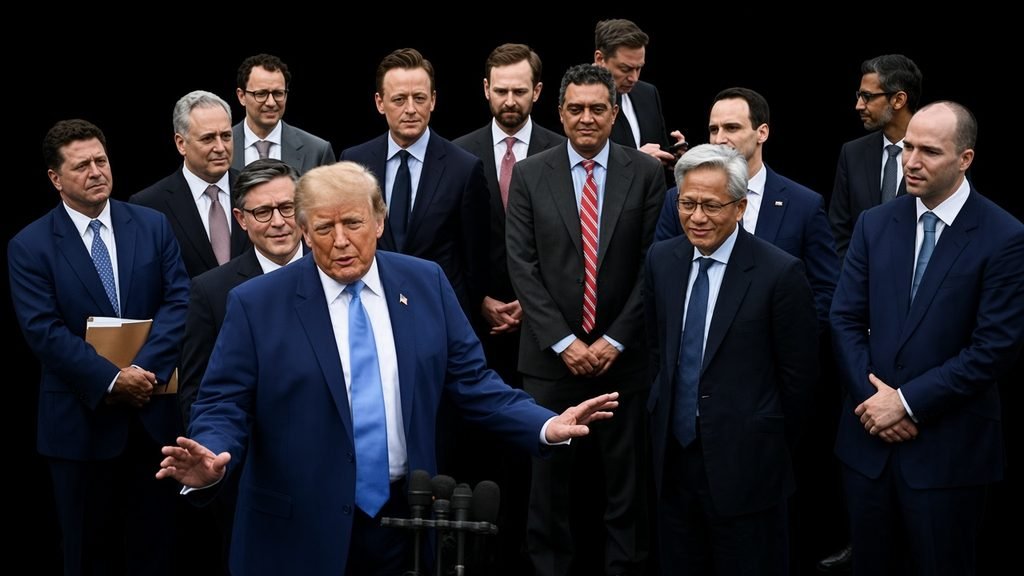
Huang’s influence in Washington has increased as Nvidia has become more involved in AI policy discussions. He has met with administration officials and lawmakers and has appeared with Trump at major events.
At the All-In Summit earlier this month, Huang took a phone call from Trump while on stage. Trump said robots would not take over the world, while Huang responded that the United States should make sure everyone wins the AI race.
The Trump administration frequently points to the global AI competition as a reason to keep U.S. development moving quickly. The administration has argued that slowing domestic AI development could weaken the United States against China.
Sarah Kreps, director of the Tech Policy Institute at Cornell University, said Huang’s business interests and his support for faster AI development are closely connected. She also said Trump may see Huang as an important ally because of Nvidia’s economic and national security importance.
Stephen Witt described Huang as Trump’s most influential adviser among technology executives. Witt also suggested that some of Trump’s comments about AI risks match positions Huang has expressed for years.
Washington Ties Grow
Huang’s role in Washington has expanded as Nvidia has become more active in technology policy. The company has also increased its operations in Washington during Trump’s second term.
Nvidia entered the election spending arena late last month by launching a corporate political action committee funded by employees.
Huang has also appeared in high-level White House settings. He was among a small group of executives who sat with Trump and Chinese President Xi Jinping during a state dinner at the White House.
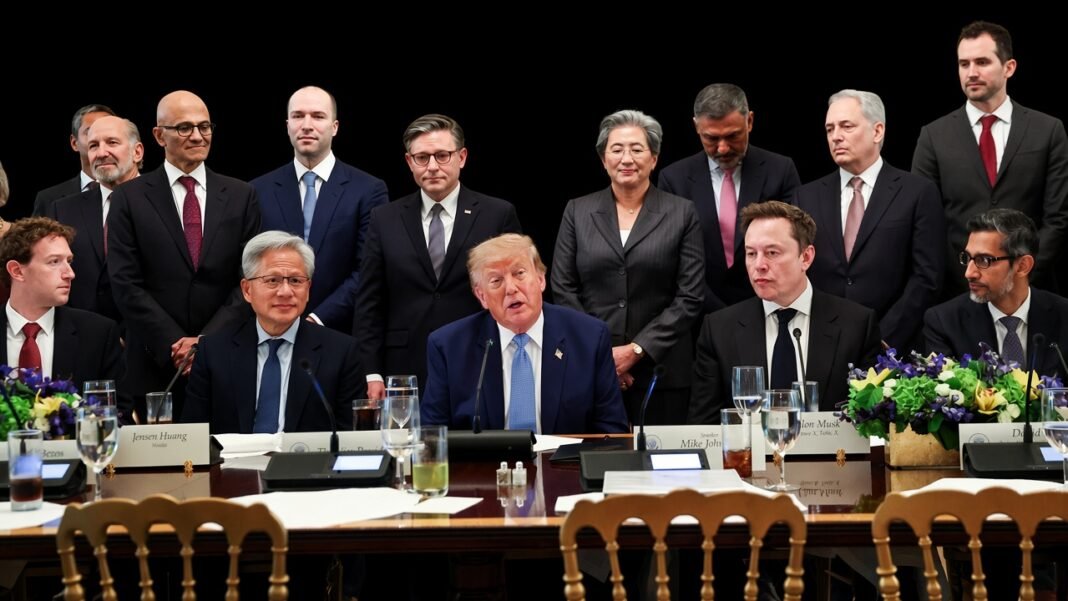
A White House seating chart for an AI lunch Tuesday showed Huang sitting directly next to Trump, with billionaire and former Trump adviser Elon Musk on the other side.
Nvidia’s China Chip Deal
Nvidia’s relationship with the Trump administration has also affected its business in China. Late last year, Trump reversed course and allowed Nvidia to sell its H20 chips to China under an agreement that gave the U.S. a 15 percent share of the revenue.
The administration later cleared Nvidia to sell its more powerful H200 chips to China under a 25 percent revenue-sharing arrangement.
The decisions came as Nvidia continued to manage its business between the United States and China. Zhiqun Zhu, a political science and international relations professor at Bucknell University, said many business leaders prefer engagement with China rather than a more confrontational approach.
AI Growth and Nvidia’s Business
Nvidia is spending billions to support the expansion of data centers, while other companies are purchasing Nvidia equipment for their own projects.
Witt noted that some of these data center projects are funded through debt, including in some cases subprime debt. He said Nvidia has strong financial reasons not to give in to calls for a slowdown.
Kreps said a slowdown in AI development would have a negative effect on Nvidia, while also noting that Huang may support rapid development because he believes in the technology.
As the AI industry faces continued debate over safety, regulation and competition with China, Huang remains closely aligned with Trump’s push to keep U.S. AI development moving forward.